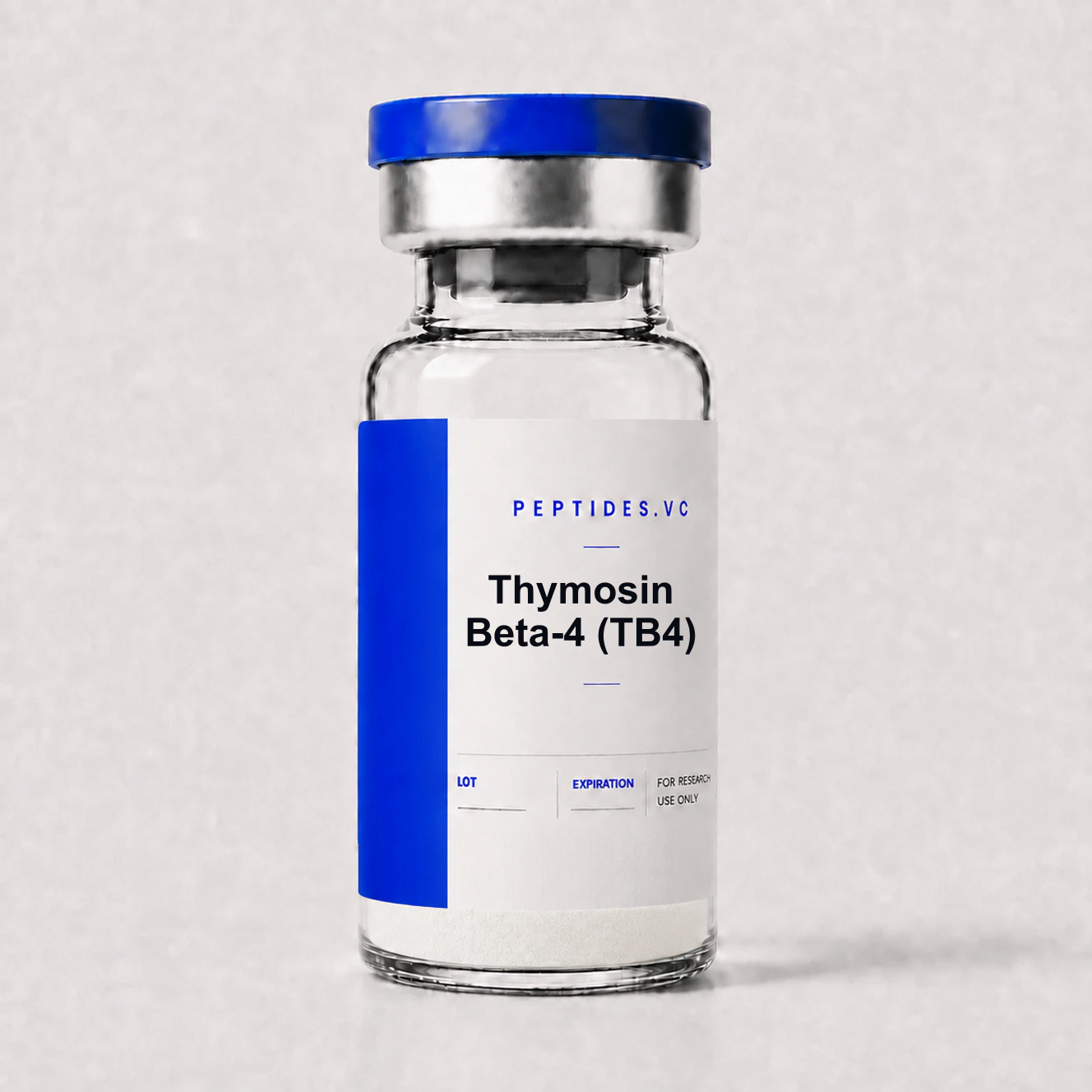
About the compound
N-acetylated 43-residue β-thymosin (UniProt P62328). C₂₁₂H₃₅₀N₅₆O₇₈S, MW 4963.44 Da.
Thymosin β-4 is a 43-residue acidic peptide with an N-terminal acetyl group and a free-acid C-terminus. Its central LKKTET motif corresponds to the actin-binding region characterized in primary literature. Empirical formula C₂₁₂H₃₅₀N₅₆O₇₈S; MW 4963.44 Da.
Reconstitution. For in-vitro laboratory handling, dissolve with bacteriostatic water (0.9% benzyl alcohol). Compound is hygroscopic — handle in low-humidity conditions and re-cap immediately.
Stability profile. Lyophilized: stable at room temperature for up to 30 days sealed; long-term storage at -20 °C recommended. Reconstituted material: stable at 2–8 °C for up to 14 days.
Selected primary literature.
- Safer D & Nachmias VT, 1994, Bioessays 16(7):473 — structural characterization of the β-thymosin / actin-monomer interaction (preclinical in-vitro study).
- Goldstein AL et al., 2005, Expert Opin Biol Ther 5(11):1505 — review of the structural biology of β-thymosin isoforms.
What remains uncharacterized: concentration-response relationships in any specific in-vitro model system are not implied here. The literature cited above describes molecular-level observations only.
For research use only. Not for human or animal consumption.